Ethnic America by Thomas Sowell
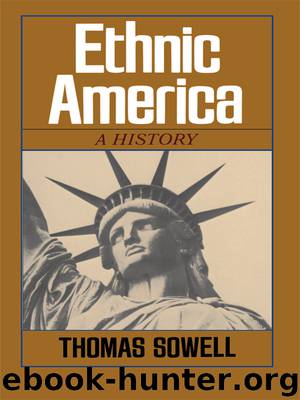
Author:Thomas Sowell [THOMAS SOWELL]
Language: eng
Format: epub
Publisher: Basic Books
Published: 2012-01-01T05:00:00+00:00
The Japanese have no consistent income advantage in families with one breadwinner (see above), and in almost no category do they have an economic advantage as large as their 32 percent higher family incomes—which results from their different distribution among these categories. More Japanese are working, and more are in higher educational brackets.
The economic and social positions of Japanese-American families are enhanced by their smaller families. While the average American woman in the thirty-five to forty-four-year-old bracket has three children,157 the average Japanese-American woman in the same age bracket has 2.2 children.158 With fewer children to support and higher incomes, the Japanese-American family has not only a higher standard of living but also can more readily afford to send its children to college to perpetuate its advantages. But again, it is necessary to distinguish the situation of the current generation from the factors that led to the initial rise of Japanese Americans. The Issei had larger than average families, just as the Jewish immigrants had larger than average families. In neither case did the larger family imply neglected children or disruptive behavior in school. Later generations had smaller families to fit a new life-style and college aspirations for children.
By any index, Japanese Americans are assimilating. Nationally, about 12 percent of married Japanese-American men and about a third of married Japanese-American women had spouses of a different race in 1970.159 In Los Angeles County in the early 1970s, about half of all new Japanese-American marriages were intermarriages.160 The same was true of Hawaii.161 Among the youth, the high grade point average of earlier generations of Japanese-American students was found to be gradually declining toward the norm, while social problems among them were rising.162
Japanese Americans have made notable contributions in many aspects of American life. The beautiful and imaginative designs of architect Minoru Yamasaki can be seen in buildings and structures from coast to coast, including the Woodrow Wilson School at Princeton, the Oberlin Conservatory of Music, the St. Louis Airport, and the Seattle World’s Fair.163 In the field of semantics, S. I. Hayakawa established a renowned scholarly reputation long before he became known to the general public as president of San Francisco State College and then United States senator. Japanese Americans have been relatively late participants in politics on the mainland but have been more active in Hawaii, where they have constituted a larger proportion of the population. In 1959, Daniel K. Inouye, a hero of World War II who lost an arm in battle and received a battlefield commission, was elected to the U.S. House of Representatives and later (1962) was elected to the U.S. Senate, where he still serves. In 1976, Hawaii also sent Masayuki Matsunaga to the U.S. Senate as the third Japanese-American senator164—3 percent of the Senate from less than half of 1 percent of the population. It was symbolic of the remarkable achievements of Japanese Americans.
Download
This site does not store any files on its server. We only index and link to content provided by other sites. Please contact the content providers to delete copyright contents if any and email us, we'll remove relevant links or contents immediately.
| Anthropology | Archaeology |
| Philosophy | Politics & Government |
| Social Sciences | Sociology |
| Women's Studies |
Cecilia; Or, Memoirs of an Heiress — Volume 1 by Fanny Burney(32558)
The Great Music City by Andrea Baker(32019)
Cecilia; Or, Memoirs of an Heiress — Volume 2 by Fanny Burney(31956)
Cecilia; Or, Memoirs of an Heiress — Volume 3 by Fanny Burney(31942)
We're Going to Need More Wine by Gabrielle Union(19046)
All the Missing Girls by Megan Miranda(16029)
Pimp by Iceberg Slim(14508)
For the Love of Europe by Rick Steves(14121)
Bombshells: Glamour Girls of a Lifetime by Sullivan Steve(14076)
Talking to Strangers by Malcolm Gladwell(13370)
Norse Mythology by Gaiman Neil(13367)
Fifty Shades Freed by E L James(13243)
Mindhunter: Inside the FBI's Elite Serial Crime Unit by John E. Douglas & Mark Olshaker(9344)
Crazy Rich Asians by Kevin Kwan(9292)
The Lost Art of Listening by Michael P. Nichols(7506)
Enlightenment Now: The Case for Reason, Science, Humanism, and Progress by Steven Pinker(7314)
The Four Agreements by Don Miguel Ruiz(6765)
Bad Blood by John Carreyrou(6622)
Weapons of Math Destruction by Cathy O'Neil(6281)
